Climate Implications of Diffusion-Based Generative Visual AI Systems and their Mass Adoption · ICCC 2023
Among the first peer-reviewed papers to frame mass adoption, not training, as generative AI's primary environmental risk.
iVizLab, Simon Fraser University · Part of AI ReThink
Uness is a new open-source system demonstrating a different model for AI: fully local on consumer hardware, free and private, and running on a fraction of the energy of cloud AI, a cost you can see and manage as you work. It is built for human agency: the user orchestrates the process, the tools, and the reflective journey. Version 4 is complete, version 5 is in development, and we are beginning to work with beta groups.
Uness runs on a single mid- to high-end consumer computer. No cloud, no subscription. Your prompts and conversation history never leave your machine. Unlimited, free, secure.
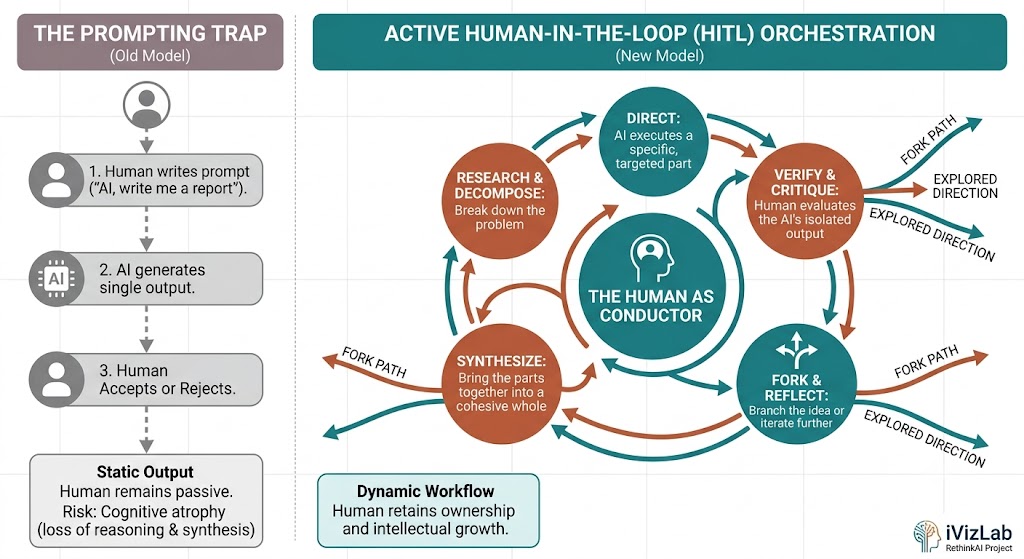
Passive prompting causes cognitive atrophy. Uness's opposite approach: active human agency. Based on our research, we've broken the AI into distinct, parts (chat, web, ...), so instead of just prompting, you journey through your goals, reflect, fork, and orchestrate.
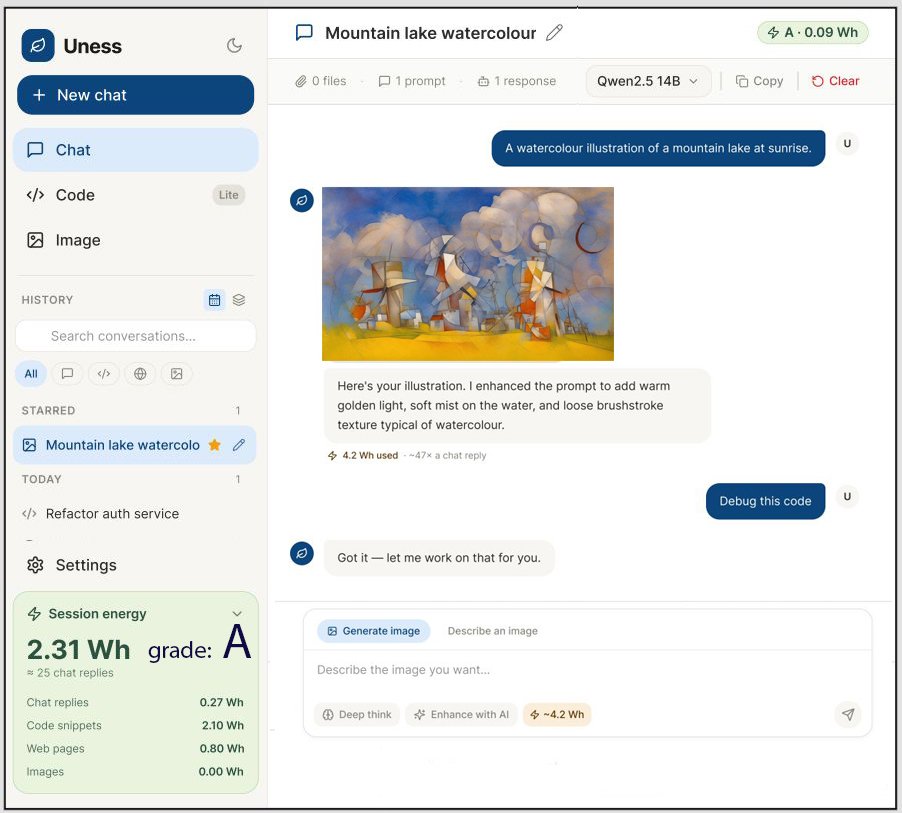
Track real-time energy right in the sidebar. Our studies show this actively shifts behavior. Powered by lean, local distilled models, Uness uses tooltips so you can scale model size to match task complexity, giving you the quality you need without wasting compute.
Why we are building it
Costly subscriptions, rate limits, and country restrictions decide who gets to use these tools and how much.
Your sensitive data is absorbed to train their models for profit, leaving you exposed to external or government surveillance.
Our research shows generating AI responses now draws energy and water at huge scales, yet no system shows you your own contribution.
Even when you choose the model, the App decides how to manage context, search the web, or use tools, leaving you out of the loop.
Consumer AI is dominated by a handful of corporate cloud platforms. They are designed to feel frictionless, and the friction they remove is your agency. Uness is a research response to all four at once. Not an oracle controlled by a few, but a transparent, sustainable medium for human work.
Our philosophy: human in the loop
The dominant pattern, you prompt and AI produces, hands the whole process to the machine: no reflection, no iteration, no real ownership of the result.
Human-in-the-loop orchestration is the opposite. It means treating AI less like an oracle and more like an orchestra you are conducting. You break a goal into steps and direct each one. You chain models and tools, and every hand-off is your decision. You fork down a promising path, run a critique loop where AI checks its own work, discard what fails verification, and synthesize a final result that is genuinely yours. You direct. AI executes. You verify.
Uness is built as an instrument set for working this way: separate model choice, web research, coding tools, and your own documents, with our current research developing the orchestration tooling around them. The goal is not better AI output. It is better human judgment, powered by AI.
The system
Uness is at version 4 and works today; version 5 is being written.
Uness runs well on a good consumer computer, but "good" matters. Our testing across model sizes:
| Tier | Models | Hardware | Our take |
|---|---|---|---|
| Excellent | 27 to 30B (e.g. Qwen 27B class, Gemma 27B) | PC with an RTX 3090 / 4090 / 5090, or a Mac with 48GB unified memory (M4 / M5) | Genuinely strong results for real knowledge work |
| Good | 14B | 16GB VRAM PC, or a 24 to 32GB Mac | Acceptable quality for most everyday tasks |
| Entry | 7 to 8B | 8 to 12GB VRAM, or a 16GB Mac | Workable for lighter tasks, quality is just good enough |
The research behind it
Five published or submitted papers underpin this work.
Among the first peer-reviewed papers to frame mass adoption, not training, as generative AI's primary environmental risk.
Five design principles: restraint, sufficiency, selectivity, material visibility, and friction as affordance.
Introduces "AI slag," distinct from AI slop, with two metrics: Slag Rate and Waste Stream Intensity.
Prompting strategy measurably predicts inference energy, operating almost entirely through output length.
The Uness system paper: users who could see per-prompt energy consumed significantly less, and asked for guidance, not just numbers.
Who it's for
Uness exists to show that AI can be something other than a corporate cloud product: free, private, community based, sustainable, and under the user's control. It is about agency: the agency of the person using it, and the agency of a democratic public deciding what AI should be. It is designed for reflective knowledge work by students and educators, non-profits, cultural institutions, Indigenous communities and organizations, academic researchers, and small organizations.
At its heart, this is a project about democratizing access to AI and empowering groups to use it for social good. By providing free, open-source, locally run tools, we aim to level the playing field so that non-profits, educators, Indigenous groups, and cultural institutions can harness AI in ways that are ethical, sustainable, and tailored to their needs: a step toward a future where AI is not controlled by a few large corporations, but is a tool for empowerment, innovation, and positive change.
We are deploying it gradually: it is in use in our lab and with students and researchers at SFU, and we are beginning beta work with a range of interested groups.
Part of AI ReThink
Uness is the knowledge layer of AI ReThink, a five-year SSHRC-funded initiative (2026 to 2030) at the iVizLab to answer corporate AI with community-grounded alternatives. Its sister project, RethinkAI, is the visual and creative layer: a new generative model built from ethically sourced pre-1932 public domain art, culturally grounded captioning developed with communities and cultural experts, and a Creative Journey interface that maps the artist's process instead of reducing it to a prompt.
Both projects share the same commitments: community grounding, human-in-the-loop orchestration, and energy transparency. And both are built to be rethought with a community, not just for one: now that the systems are underway, we are assembling collaborators across academia, government, ethics, the humanities, and computer science to work out together what AI should be.
Read about the full initiative →The name
Uness is a phonetic play on Eunice, for Eunice Newton Foote, whose 1856 experiments first showed that CO₂-rich air traps heat, an early articulation of the greenhouse effect. Her paper was read at the AAAS meeting by a male colleague, and her insight went uncredited for over a century.
A fitting name for a system built around environmental transparency and returning control to the people usually left out.
Get involved
We are beginning to onboard beta groups. Because Uness runs locally, testing requires one of the recommended hardware configurations above; there is no web version. If your organization has the hardware and the interest, we would like to hear from you.
Tell us about your group →We are a cognitive-science-based AI research lab building a wider community around this rethink: democracy-minded experts from academia, government, and civil society working out together what AI should be. We are looking for:
Uness demonstrates that capable, community oriented, sustainable AI can run on consumer hardware. Getting it into non-profits, classrooms, and cultural institutions takes resources. We are seeking industry partners for: